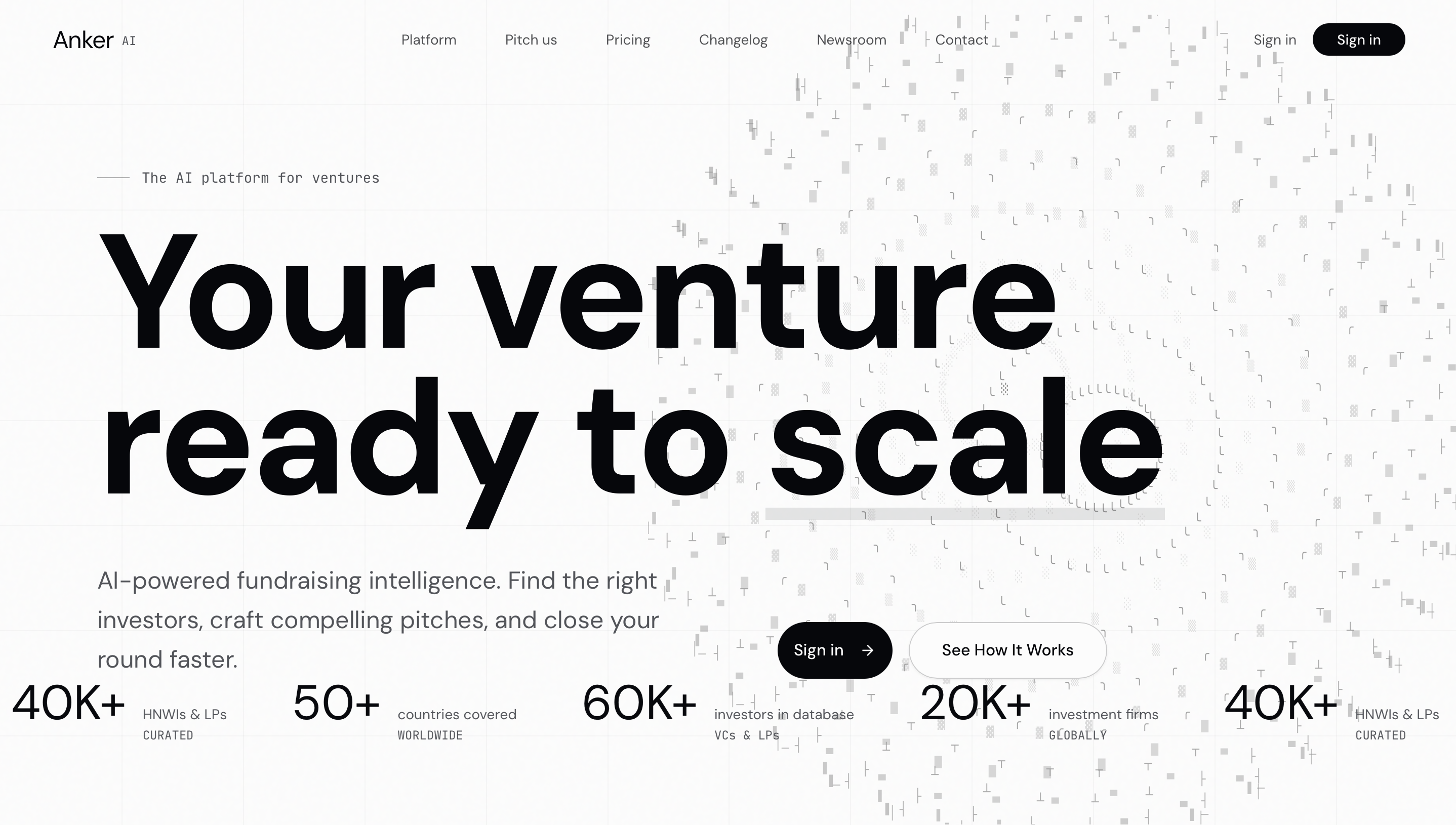
The fundraising paradox: too much noise, too little signal
Founders raising capital today face a paradox. The venture ecosystem has never been larger, with over $200 billion deployed annually in the U.S. alone. Yet, the average seed-stage startup spends 6-9 months in fundraising, contacting 100+ investors to secure a lead. For every 500 cold emails sent, only 1-2 result in a meeting. Investors, meanwhile, are inundated with thousands of pitch decks annually, most of which are misaligned with their thesis or stage.
The inefficiency is structural. Founders rely on broad outreach lists, while investors manually filter opportunities through spreadsheets and intuition. The result is a market where 80% of first meetings fail to advance, according to data from Carta. Anker AI aims to change this by building the intelligence layer between founders and capital.
What Anker AI actually does
Anker AI is not another CRM or investor database. It is a full-stack platform combining AI-driven research, matchmaking, and workflow automation to improve the quality of investor-founder interactions. The platform’s core functions are designed to address the specific pain points of each user segment:
For founders: precision over volume
Founders use Anker AI to identify investors who are not just possible fits, but probable ones. The platform’s matchmaking engine evaluates:
- Sector alignment (e.g., climate tech vs. fintech).
- Stage specificity (pre-seed vs. Series B).
- Geography (e.g., Bay Area vs. European deep tech hubs).
- Check size (e.g., $500K seed vs. $5M Series A).
- Investment thesis (e.g., revenue-based financing vs. traditional equity).
Instead of blasting a generic list to 200 investors, a founder can generate a targeted shortlist of 10-15 investors who have explicitly backed similar companies in the past 12 months. The platform’s AI research layer enriches these profiles with recent portfolio activity, LP composition, and even founder-founder referrals, providing context that cold outreach cannot.
For investors: structured intelligence over noise
Investors use Anker AI to organize their deal flow with institutional rigor. The platform’s reporting module generates MBB-style insights, including:
- Sector heatmaps showing where competitors are deploying capital.
- Founder sentiment analysis from pitch decks (e.g., clarity of problem statement, traction metrics).
- Deal-flow velocity tracking (e.g., average time from first contact to term sheet).
One early user, a seed-stage fund in Austin, reported a 40% reduction in time spent on initial screenings by using Anker AI’s AI-generated deal summaries. These summaries distill a 10-page pitch deck into a two-paragraph executive brief, highlighting alignment with the fund’s thesis and key risks.
For platform operators: a single source of truth
Platform operators — whether at accelerators, scout networks, or corporate venture arms — use Anker AI to manage their investor and founder databases. The admin tooling includes:
- User management for controlling access to investor data.
- Research output tracking for auditing AI-generated insights.
- CRM integration to sync with Salesforce or HubSpot for follow-ups.
For example, an accelerator program can use Anker AI to track which investors are most active in their portfolio companies’ follow-on rounds, enabling targeted outreach during demo days.
The technical backbone: a full-stack approach
Anker AI’s repository outlines a modern web platform with distinct layers:
- Client: A React-based frontend for founders, investors, and operators.
- Server: A Node.js backend handling API requests, AI inference, and data processing.
- Shared modules: Reusable components for matchmaking, research, and reporting.
- Database: PostgreSQL for structured data and vector storage for semantic search.
- Scripts: Automated data pipelines for enriching investor and company profiles.
- Deployment: Dockerized containers for scalability, with Kubernetes for orchestration.
This architecture supports real-time updates to investor theses and founder metrics, ensuring that matchmaking remains dynamic. For instance, if an investor updates their sector focus in their profile, the platform’s AI layer recalculates matches within hours, not weeks.
Why this matters: the case for better judgment at scale
The venture market’s inefficiency is not just a founder problem — it’s a system problem. According to the Kauffman Foundation, the average VC fund takes 18 months to deploy capital, with 30% of that time spent on sourcing. Meanwhile, startups waste $20,000-$50,000 on fundraising, according to First Round Capital’s data.
Anker AI’s approach is to embed judgment into the process. Its AI research layer doesn’t just scrape LinkedIn or Crunchbase; it synthesizes proprietary data from pitch decks, founder interviews, and investor portfolios to build a nuanced understanding of both sides. For example:
- A founder raising a Series A for a B2B SaaS company might see a shortlist of investors who have backed 3+ companies in the same TAM with ARR growth >100% YoY.
- An investor evaluating a climate tech startup might receive a report showing that 60% of similar companies in their portfolio have pivoted their go-to-market strategy within 18 months.
This level of specificity reduces the “spray and pray” dynamic that plagues fundraising. It also democratizes access to institutional-grade research, which has historically been the domain of top-tier funds with dedicated scouts.
Who should use Anker AI — and when
Anker AI is designed for three primary audiences:
Founders in active fundraising
- Best for: Seed to Series B startups raising $1M-$20M.
- Use case: Replace generic investor lists with data-backed shortlists.
- ROI: Reduce fundraising time by 30-50%, increase meeting conversion rates by 20-30%.
Investors building deal flow
- Best for: Seed-stage to growth-stage funds, corporate VCs, and scout networks.
- Use case: Automate initial screenings and generate deal memos.
- ROI: Cut sourcing time by 40%, improve portfolio company follow-on rates.
Platform operators managing ecosystems
- Best for: Accelerators, university tech transfer offices, and LP networks.
- Use case: Track investor activity and streamline demo day matchmaking.
- ROI: Increase follow-on funding for portfolio companies by 15-25%.
The bottom line: a platform for the post-spray era
Anker AI is positioning itself as the intelligence layer in a market where volume has replaced precision. Its value isn’t in automation for automation’s sake; it’s in embedding judgment into the fundraising process. For founders, that means fewer cold emails and more meaningful conversations. For investors, it means less noise and more signal. For operators, it means a single source of truth for managing capital ecosystems.
The venture market is overdue for this kind of discipline. The tools of the past — spreadsheets, cold outreach, and intuition — are no longer sufficient in a market where over 15,000 startups are founded annually in the U.S. alone. Anker AI’s approach suggests that the future of venture capital will be defined not by who has the loudest megaphone, but by who has the sharpest judgment.
What to do next: Visit Anker AI’s platform to explore its investor matchmaking and pitch deck analysis tools for your next fundraising round.